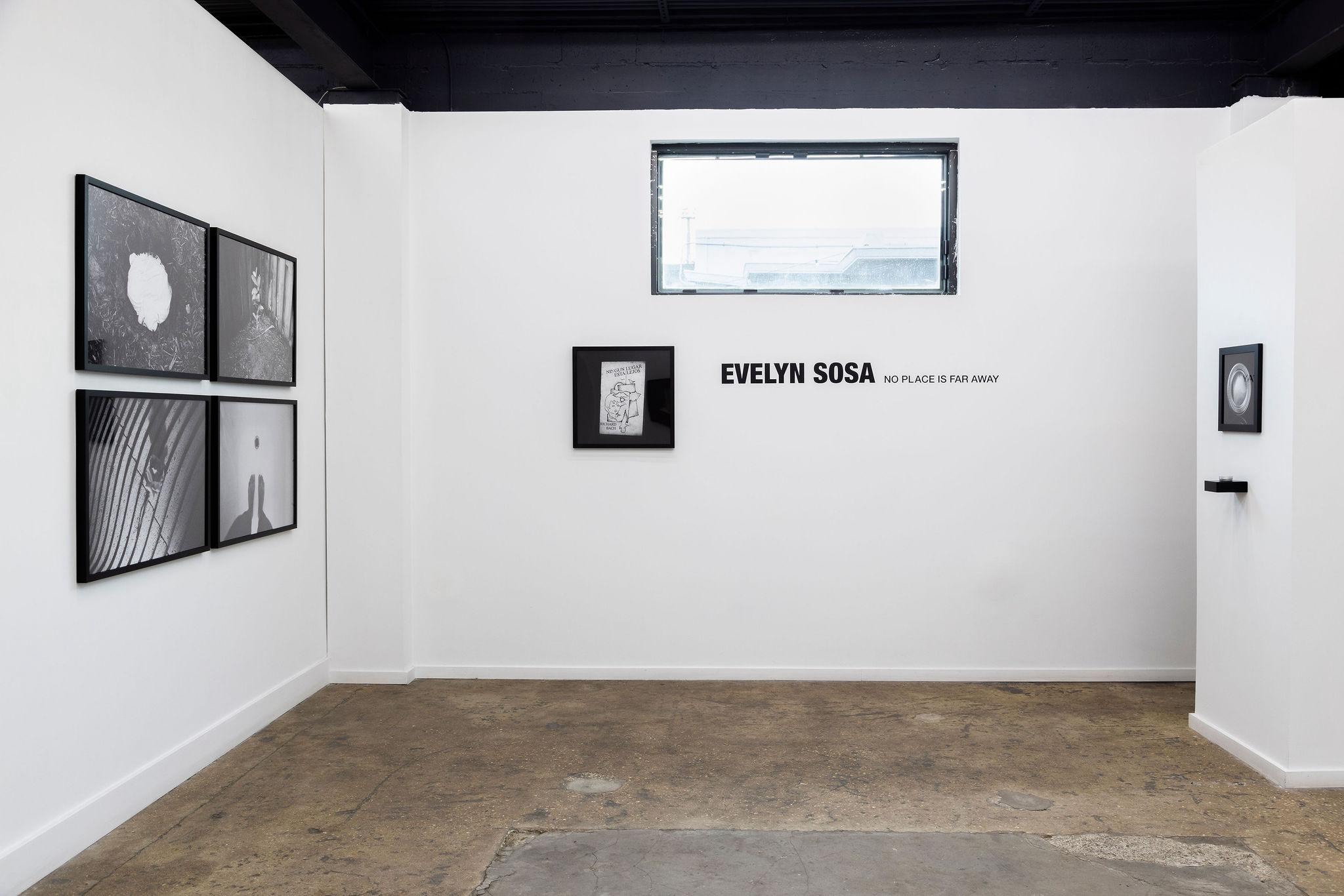
“No Place is Far Away” is a thoughtful, paired-back take on ingenious archival work and memory permanence. Through (mostly) black-and-white photography, Cuban artist Evelyn Sosa explores the deeply American history of immigrants leaving everything behind in their country of origin, through the vantage point of Cuban immigrants, waves of which have shaped Miami and made it what it is today.
Each piece in the exhibit, which is on view through Friday, June 6, at Miami’s Mahara+Co., reflects a different individual Sosa interviewed.
In the three years since Sosa began the series while studying at the International Center of Photography (ICP) in New York City, she has interviewed 20 individuals spanning different generations, different socioeconomic and political backgrounds, with varying reasons for leaving Cuba. They span different clusters of migration in the 60 years since the Cuban Revolution and the start of Cuba’s communist dictatorship. After her interview, Sosa will either photograph her interviewees in intimate, still portraits or will photograph a very intimate part of her subject’s immigration stories — the item they took with them when leaving Cuba.
The narrative is a familiar one — a Cuban national finds themselves cornered by the hardships of living in Cuba, the lack of resources, the lack of opportunities, the lack of everything. In the case of two of Sosa’s subjects, they may also be facing government retaliation for political activism, physical violence, or even imprisonment.
They are then confronted with the prospect of leaving their country, leaving everything and everyone they know behind, perhaps permanently. They finally realize that they must leave, and do so with little more than the clothes on their back.
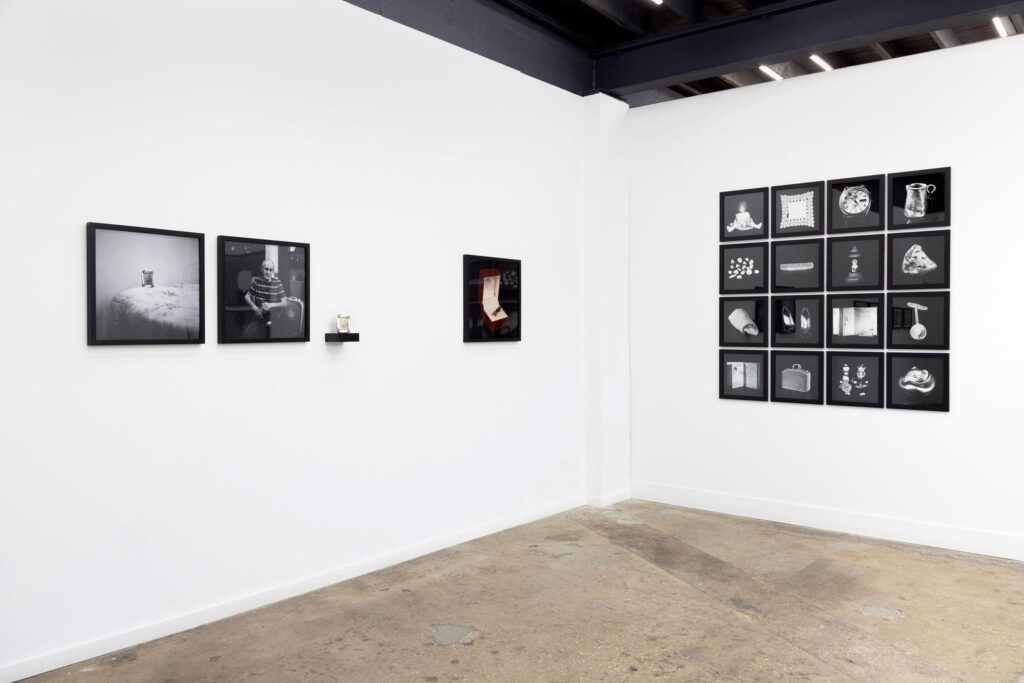
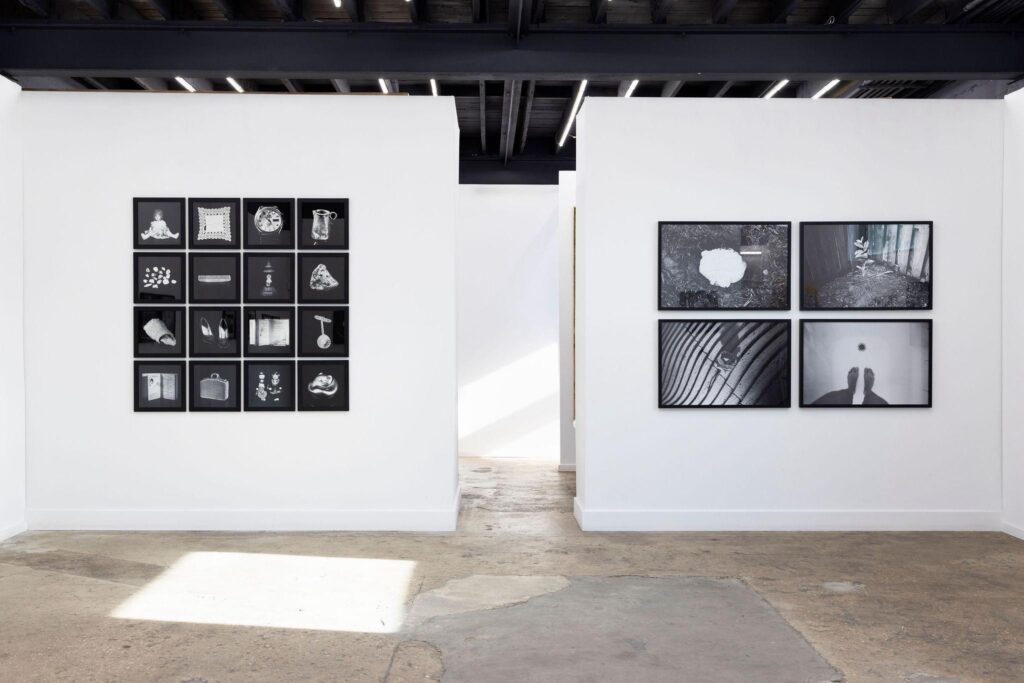
“No Place is Far Away” focuses on the memorabilia, the small tokens of home people choose to hold onto in an entirely treacherous ordeal to a new world. On the back left wall are several objects, each reflecting a different person and a snippet of their life in Cuba.
One image is a miniature of the Catholic patron saint of Cuba, La Virgen de la Caridad del Cobre, affectionately nicknamed “Cachita” and a recurring visual motif in many artistic practices discussing life in the Cuban diaspora. Others are seemingly nondescript, ordinary tokens that others may misconstrue as junk, like a cat paperweight, a rock, or a miniature pendant shaped like a water jug. But these items have a life to them, like the archeological items found in museums. They have an ascribed, immaterial value thanks to their provenance, the material culture imbued in them by time and place.
To the left of the collection of images, one such photographed item captures attention. The only color photograph in the exhibition shows off the rich red of an old jewelry box, holding two dried ends of umbilical cords. It is a tradition in some cultures that, once a newborn baby has been brought home and the stump of the umbilical cord that is left on its stomach finally falls off, mothers will keep these stumps and dry them for safekeeping.
Such things are done in Cuban families with baby teeth or even the hair from a child’s first haircut. Pondering the image and understanding that this is the object a mother chose to take with her, the story becomes more complex and intimate. Did she have to leave her two children behind, or did they arrive with her? Parenthood layers into immigration in many facets and is often part of how immigrant communities frame their decision to move (i.e., “I want my children to have more opportunities than I did”, “I want to send money back to my children so they can survive”). The relationship between parent and child takes on new dimensions in these contexts, new stakes that hold survival and success in them at the same time.
As a Cuban immigrant, Sosa, who has lived in Miami since 2023, has imbued her own experience within the exhibition. Works on the back right corner are photos of the burial mound of one of that cats she bought with her from Cuba. There’s the image of a book by Richard Bach, whose title (Ningún Lugar Está Lejos) is also the title of the project. These are ways for Sosa to place herself within the greater context of Cuban immigrants starting over in a new country. Sosa later kept a lock of the cat’s hair in a display case, installed in the exhibition with an accompanying photo and on the wall directly facing the burial image.
On another wall is a portrait of a man. There’s a shelf next to the portrait that holds a miniature, antique photo in a simple frame. The man in the portrait is named Armando, and the small photo next to him is the photo of his mother he carried with him when he left Cuba over 30 years ago.
Sosa interviewed him last year, and before she could show him the photo she created, he passed away. The photo of his mother, along with all of Armando’s possessions, was to be sold or disposed of because he had no next of kin in Miami. It is only because Sosa came to his home to claim the photo that the prized possession of his did not end in a trash heap.
On the right wall by the entrance, two women are portrayed staring gravely into the camera. Their names are Camila Lobón and Katherine Bisquet, two Cuban activists who faced criminal charges and persecution in their country for speaking out against the Cuban government. To their left hangs a photo of one of the objects Katherine brought with her, a small drawing by Luis Manuel Otero Alcantara, a performance artist and dissident of the Cuban government who is remains in prison.
Sosa has dedicated this section to honor the bravery it takes to speak out against a system designed to snuff out all dissidence. A timely message for today.
WHAT: “Evelyn Sosa: No Place is Far Away”
WHERE: Mahara+Co., 224 NW 71st St., Miami
WHEN: 11:30 a.m. to 5:30 p.m., Tuesday through Saturday. Through June 6.
COST: Free
INFORMATION: (786) 498-8706 or mahara-co.com
ArtburstMiami.com is a nonprofit media source for the arts featuring fresh and original stories by writers dedicated to theater, dance, visual arts, film, music, and more. Don’t miss a story at artburstmiami.com.