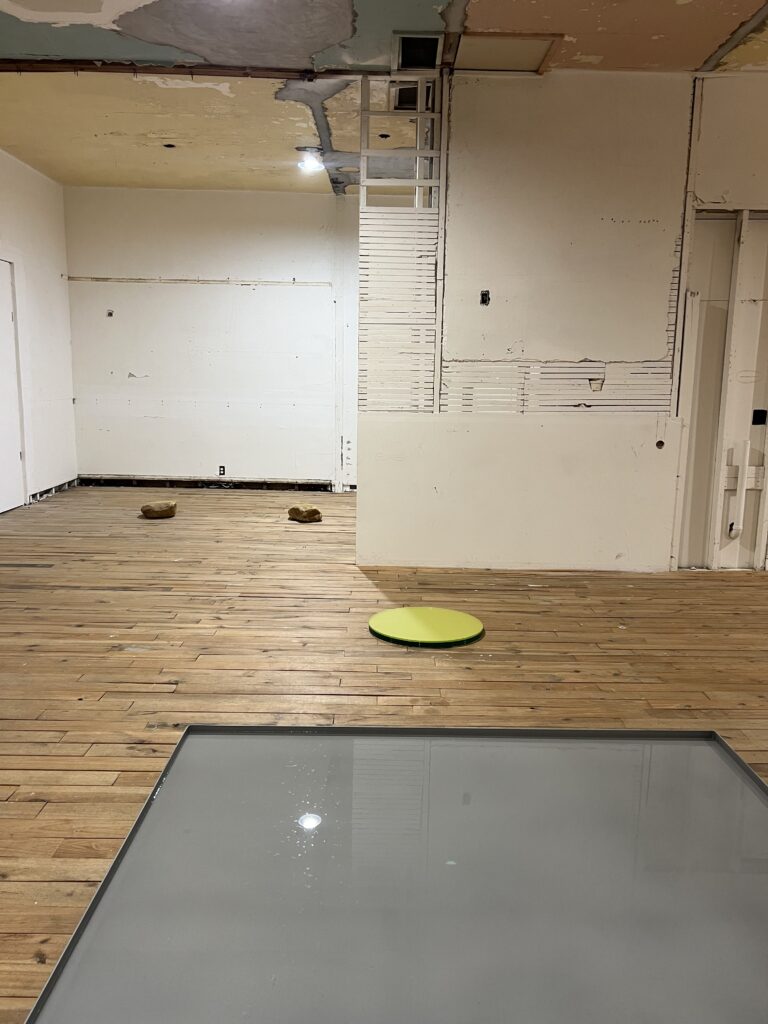
Luna Palazzolo-Daboul and Fared Manzur unveiled two solo exhibitions (Palazzolo’s is titled “Fantasy Life”), both of which are hosted in Manzur’s studio space. Rice Hotel, as Manzur calls it, is an expansive, ramshackle walk-up in downtown Miami, whose walls, painted in faded colors of off-white, purple, and green, crack and crumble throughout, exposing underlying piping and concrete. Manzur opens the studio to the public on occasion, usually to exhibit alongside other artists.
Palazzolo has recently participated in a string of group exhibitions at galleries like KDR and Voloshyn Gallery, and supported several that were programmed through her own studio and exhibition space in Little Havana, known as Tunnel studios. “Fantasy Life” is an opportunity to focus exclusively on her personal practice, which is long overdue after so much work on her behalf in support and alongside other artists.
Palazzolo’s art is in one of the larger rooms of the Rice Hotel, to the left of the stairway guests use to enter the space. The show is minimal, with only four or five works made in industrial materials installed at opposite ends of the room. The arrangement and colors denote a sensitivity to the space they are held in, allowing Palazzolo’s work to blend in eloquently without getting lost in a room that is clearly more dynamic than the typical white cube.
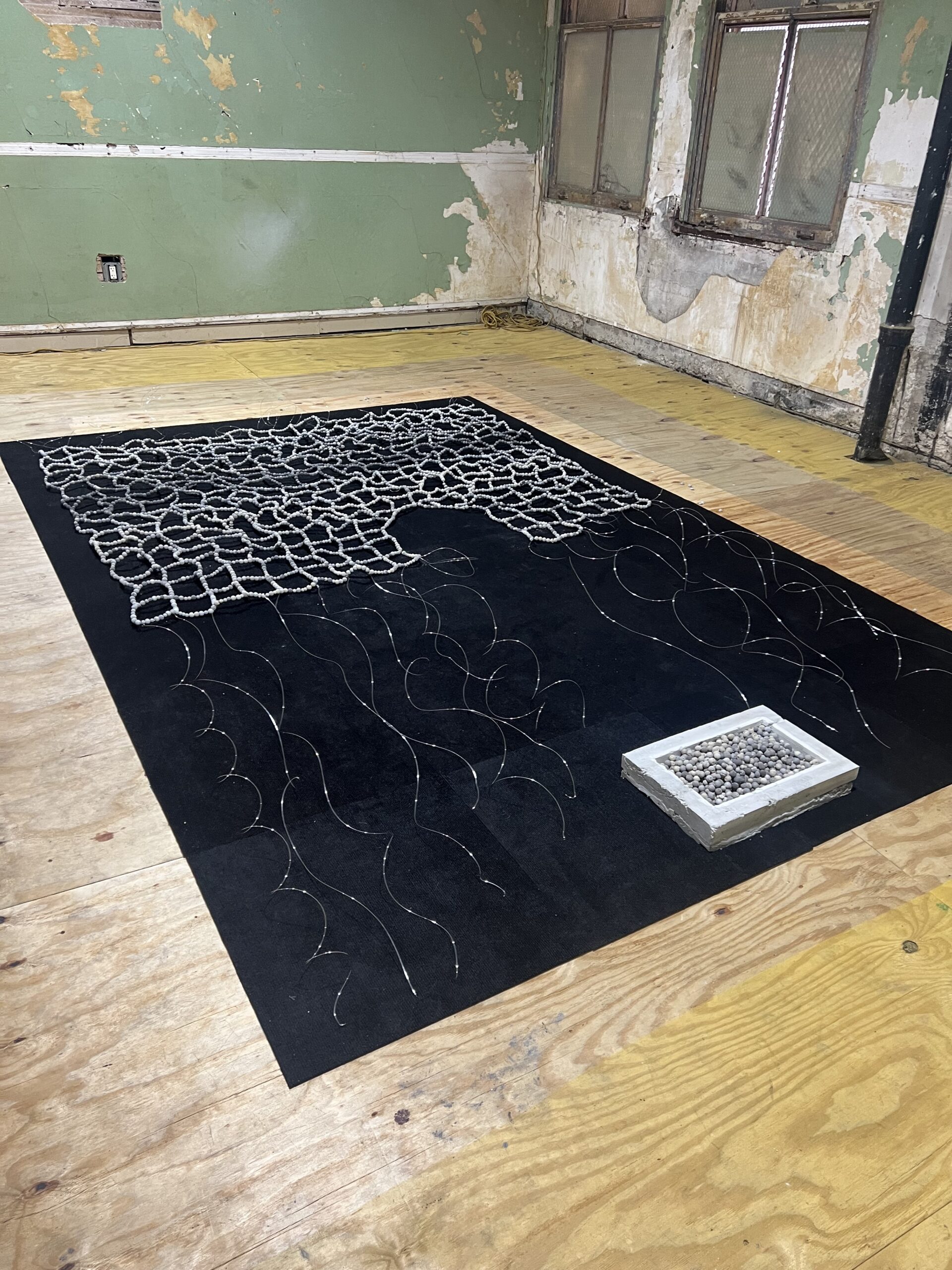
The back of the room features “Safety Net” (2025), a large tapestry made of concrete beads woven into a square pattern with wire, laid over a black tarp. The left side of the concrete beads gradient from gray to black and back to gray before the ends of the wire show through the right side of the work. Next to the nonwoven ends sits a tray of unused beads, some of which have seemingly spilled over and were crushed into dust by footsteps.
Palazzolo likes to think of this and all her works as living organisms that may spend several months in different evolutions. They need not gain gravitas by simply being finished. Unfinished in this case does not mean unintentional, as the tray of beads inevitably waiting to be incorporated into the tapestry introduces a layer of tension (or mystery) as to what the work will become in its end state.
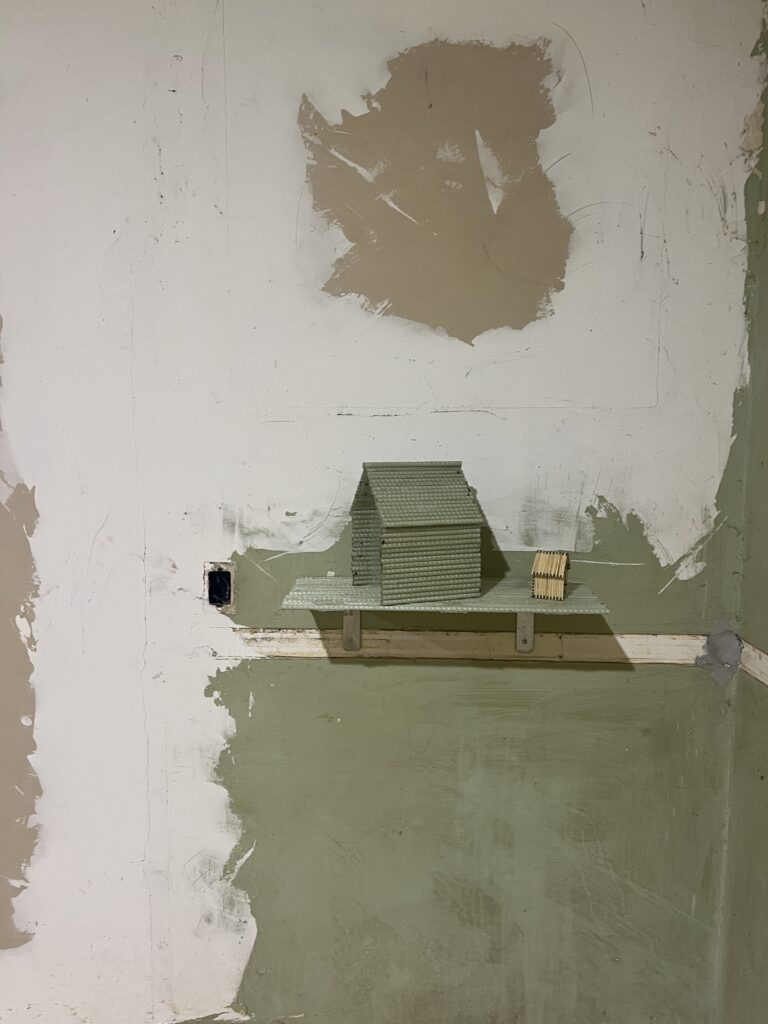
On the opposite end of the room, Palazzolo has installed “Die Wunde schliesst der Speer nur der Sie schlug” (2025) (“Only the spear that struck the wound can close it”), a small house standing on a shelf, both of which are made entirely out of fiberglass.
The fiberglass has a vague greenish hue to it, highlighted by the faded green of the wall it hangs on. In her practice, Palazzolo focuses heavily on industrial materials as a way of turning things perceived as artless or overtly masculine on their head. Fiberglass is used for its durability and insulating capacity in homes, since, as Palazzolo explained, the material does not expand or contract at different temperatures. Housing materials in artistic practice are fitting for an environment that is constantly under simultaneous construction and degradation, with sea levels continuing to rise, potholes throughout the city and as our own infrastructure buckles under the weight of an ever growing population.
Materials such as these will continue to be directed towards more highways, more buildings, and more and more housing to accommodate both the people who flock Miami to escape their woes elsewhere and those who use it as a place to park their money.
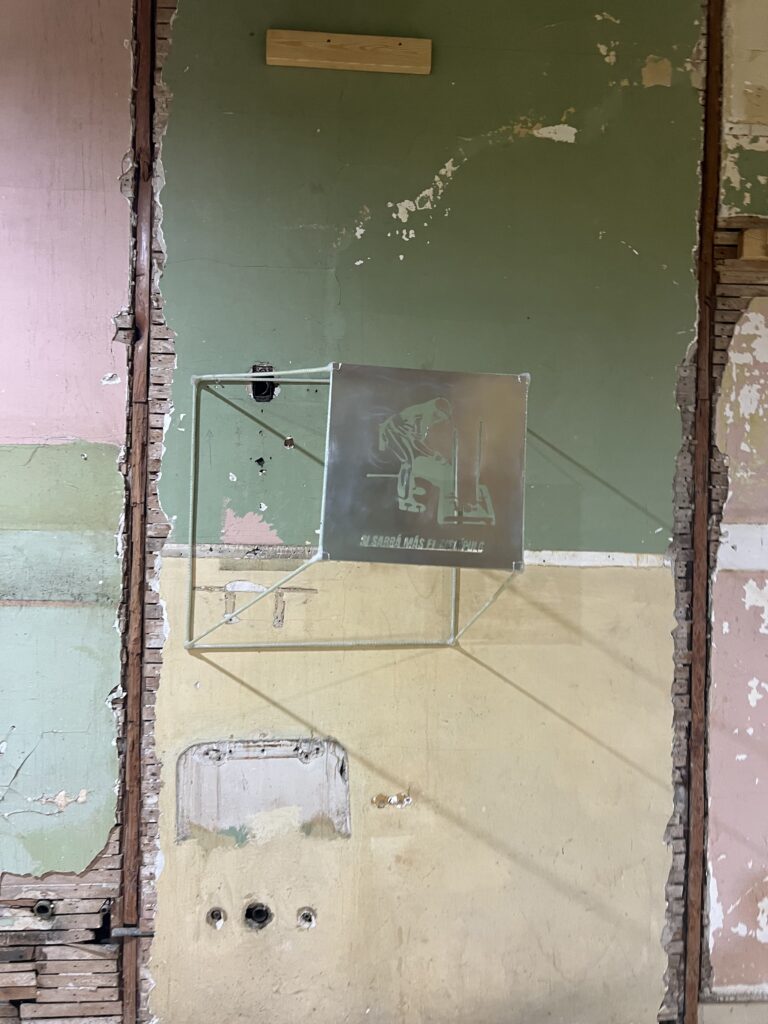
On the right side of the room, a steel cut image is projected from the wall with fiberglass rods arranged in an off center trapezoid. In it, Palazzolo is seen pouring cement. The words “SI SABRA MAS EL DISCIPLE” (“Might not the pupil know more? “) are written under the image, quoted directly from one of Francisco de Goya’s caprichos.
Goya’s print with this quote originally features a master donkey, seemingly instructing a disciple. This piece is one of four images in the “De que mal morirá” series (“Of what ill will it die”), each referring to a different piece by Goya and meant to lay next to each other on the floor in a sort of pyramid shape. Palazzolo doesn’t mean to recreate the capriccios herself. One could never recreate Goya’s work or that of any other great artist, but all art is iterative, an amalgam of art already created, borrowing references and themes from surrounding influences.
In this case, Palazzolo borrows from another artist who shares the same irreverence for societal norms, all while questioning our society’s worship of labor. When examining this piece and considering its phrase at the bottom, viewers may ask themselves who in this image is the disciple and who is the master. Is Palazzolo a disciple of her own work, to the labor that, in a capital-driven economy, may be her only thing to barter? Or is she the master, bemoaning a lack of knowledge and understanding most viewership has in a city like Miami, where her work isn’t easily boxed into conventional categorizations?
Another artist whose practice is not easily categorized, Manzur has installed some of his most recent work in several of the rooms of Rice Hotel. Many are large, shallow, and opaque basins filled with water, each coupled with a bright green, circular glass panel on the floor beside them.
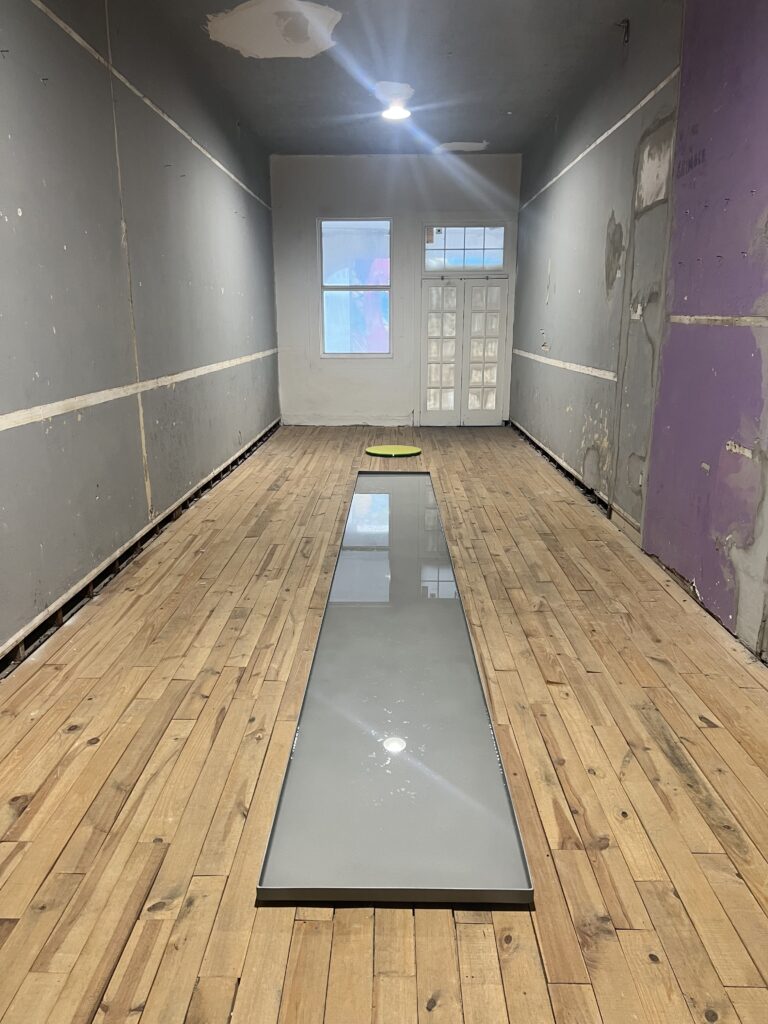
Manzur explores mathematics in his work. With the basins, he begins with the lifespan of a mosquito. A mosquito can, on average, live up to 14 days, just long enough for them to develop and reproduce with a mate. Each basin of water contains exactly enough water to evaporate in 14 days within a controlled environment, an impressive feat considering each basin has unique dimensions. Some are long and narrow to fit one of the rooms across the hall, while others have more square dimensions and appear to be much larger.
Through several calculations of length, width, and depth, Manzur achieves these different sizes while guaranteeing that each basin can hold an equivalent volume of water. The volume of the glass panels represents one day in water evaporation and a mosquito’s life. Within the Rice Hotel, this ideal evaporation rate is lost to the conditions of the building, since the lack of air conditioning means that the different rooms will be at different temperatures throughout the day. The water surface holds dust particles and the wings/ shells of bugs that inhabit the building, a sign of the wear and tear in the very space that hosts the work.
Manzur encourages that the water be sullied as part of their exhibition to the public. Visitors may splash the water around or pour more water into the basins if they would like to. These happenstance “interventions.” along with the dirt and grime, are metaphors for a life truly lived. No living being exists in a vacuum that dictates completely ideal circumstances.
Both exhibitions typify the value of artist-run spaces, from the non-sanitized look of the Rice Hotel to the dynamics of the shows themselves. Both are by appointment and do not have a set closing date, with little promotion or push for press. What this experience of Manzur and Palazollo’s work may lack in the “polished professionalism” viewers would find at a local museum or establishment gallery, they make up for in earnest, intellectual, conceptually driven projects that grow rarer and rarer in the local arts landscape.
WHAT:“Fantasy Life” by Luna Palazzolo-Daboul and an not yet titled installation by Fared Manzur
WHERE: Rice Hotel, 30 N. Miami Ave., Miami
WHEN: By appointment. Contact @faredmanzur, @lunapalazzolo, or @rice.hotel on Instagram
COST: Free
INFORMATION: ricehotel.org
ArtburstMiami.com is a nonprofit media source for the arts featuring fresh and original stories by writers dedicated to theater, dance, visual arts, film, music, and more. Don’t miss a story at artburstmiami.com